Every marketing platform you use is collecting data right now. Clicks, opens, impressions, sessions, follower counts. Your AI tools can read all of it in seconds.
So why does it still feel like nobody can say what's working?
Because more data doesn't mean better intelligence. Intelligence is knowing which numbers reflect something that actually worked, and which are noise, guesses or habits nobody ever tested. Most AI marketing skips that step, and it's a big part of why so much of it isn't paying off. Most are just failing faster. More content, same endpoint.
Key Takeaways
- Intelligence comes from knowing what has been proven to work, kept separate from what is only assumed.
- AI efforts that stall are rarely short on data. The research points to data that isn't fit for the job, it's being pointed improperly, or systems being used aren't learning from what happened.
- CMOs estimate 45% of the data their teams use to make decisions is incomplete, inaccurate, or outdated.
- Start with the question, not the dataset, and ask of every finding: how do we know that worked?
What Does “More Data Doesn't Equal Better Intelligence” Mean?
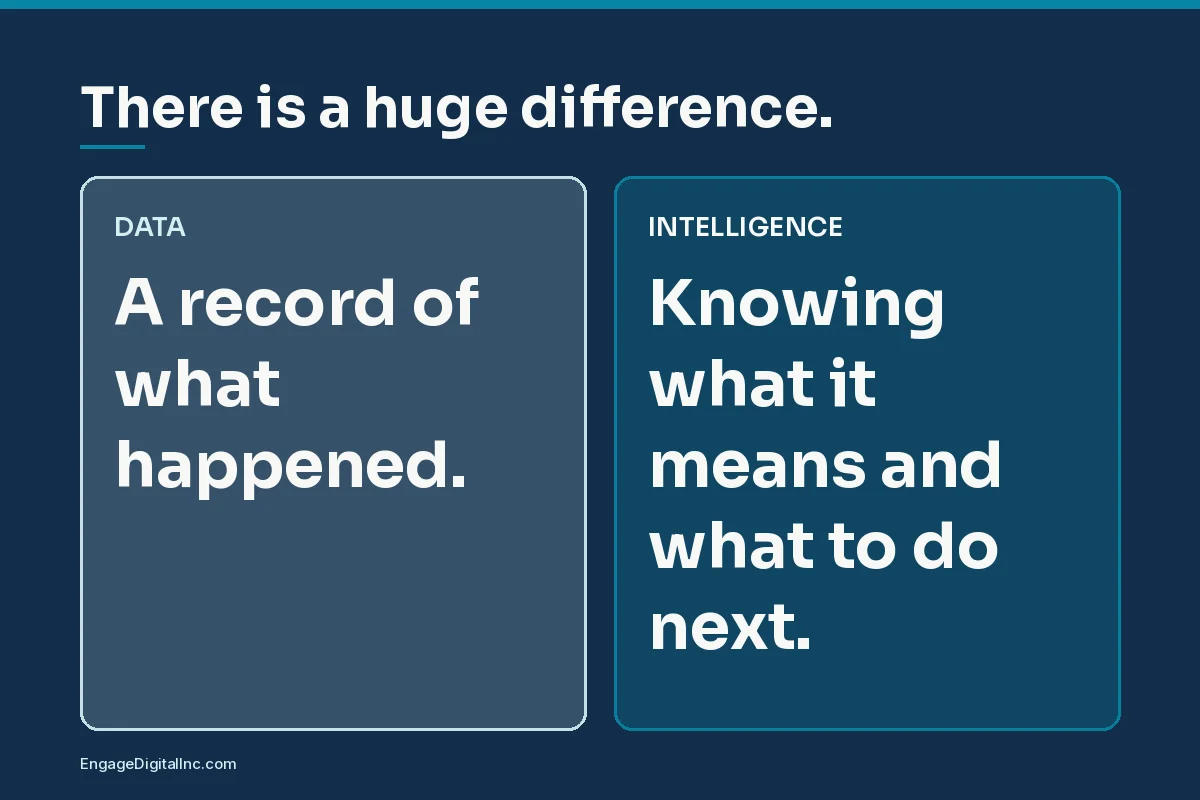
Data is a record of what happened. Intelligence is knowing what it means and what to do next.
Data is NOT automatically meaningful information that equates to making smarter decisions, pointing to what should be done next.
There is a HUGE difference between these two.
Adding more data doesn't add understanding on its own. If the extra data repeats what you already know, it adds nothing. If it's wrong, it takes something away. And if nobody separates what was tested from what was guessed, the guesses start to look like facts simply because they show up in the report. What's worse is a substantial amount of data with nobody on the team looking at it or even having the ability to glean insights from it.
Researchers see this inside AI itself. A University of Toronto Engineering study found that a model trained on only 5% of a materials dataset performed about the same as one trained on all of it, for predictions inside the dataset's domain. As the lead researcher put it, “We need to pay attention to the information richness, rather than just gathering as much data as we can.”
Why Are So Many AI Projects Falling Short?
Mostly because of what they're fed and what they fail to learn, not because the models are weak. In IBM's 2025 CEO Study of 2,000 CEOs, respondents said only 25% of AI initiatives delivered the expected ROI.
MIT's Project NANDA, in its State of AI in Business 2025 report (preliminary findings), found that 95% of organizations were getting zero return from generative AI. It names learning as the core barrier: “Most GenAI systems do not retain feedback, adapt to context, or improve over time.”
Gartner points the same way from the data side. It predicts that through 2026, organizations will abandon 60% of AI projects unsupported by AI-ready data, and it defines AI-ready data as data that is “representative of the use case.” Not the most data. The right data for the job.
The point here is that data by itself, or even MORE data, isn't what makes your AI effective. It's having the ability to decipher the data properly and adjust the related activity based on that wisdom.
How Does This Show Up in Marketing?
Marketing may be the easiest place to confuse data with intelligence. Every platform hands you a dashboard with a dozen numbers that can go up.
Many of those numbers can't be trusted. In Adverity's 2025 survey of 200 CMOs, respondents estimated that 45% of the data their teams use to make decisions is incomplete, inaccurate or outdated. Yet 85% said they trust the quality and completeness of their marketing data. The data is known to be flawed, and decisions get made on it anyway.
Honestly, I think this is maddening, isn't it?
Adding more of it hasn't solved the problem. Gartner found marketing analytics influenced only 53% of marketing decisions, and teams that answered with more data or more technology still saw no tangible impact on key outcomes. A third of respondents said decision makers cherry-pick data to support a decision they'd already made.
This reflects the death of the old marketing model, and we intend to be a driving factor of its death!
What Happens When AI Counts Guesses as Facts?
It produces confident plans built on things nobody proved. In the Gartner 2025 CMO Spend Survey, CMOs said GenAI was paying off through time efficiency (49%), cost efficiency (40%) and the capacity to produce more content (27%). Real gains. But faster and more is a different thing from smarter with better outcomes. When the inputs are half wrong, AI simply produces confident output from them sooner.
Here's a made-up example. A home services company asks its AI to review a year of campaign data. It reports that Tuesday emails perform best and one ad audience converts best. But Tuesday won because one big promotion went out that day, and that audience was measured by a tracking tag that fired twice on every form.
Neither finding was ever tested. They were simply in the data, so they became next quarter's plan.
What Does Real Marketing Intelligence Look Like?
It starts with what you're trying to move and counts only the evidence that moved it. The way we see it, that takes four habits:
- Start with a question. Calls, bookings, orders, repeat customers? We wrote about why that comes first in Know Your What, Know Your Why.
- Separate proven from assumed. A result that was tested and held up is worth more than a hundred correlations.
- Check back. Did it work in the business, and not only on the platform?
- Drop bad lessons. When a past win turns out to be a fluke, it stops being counted.
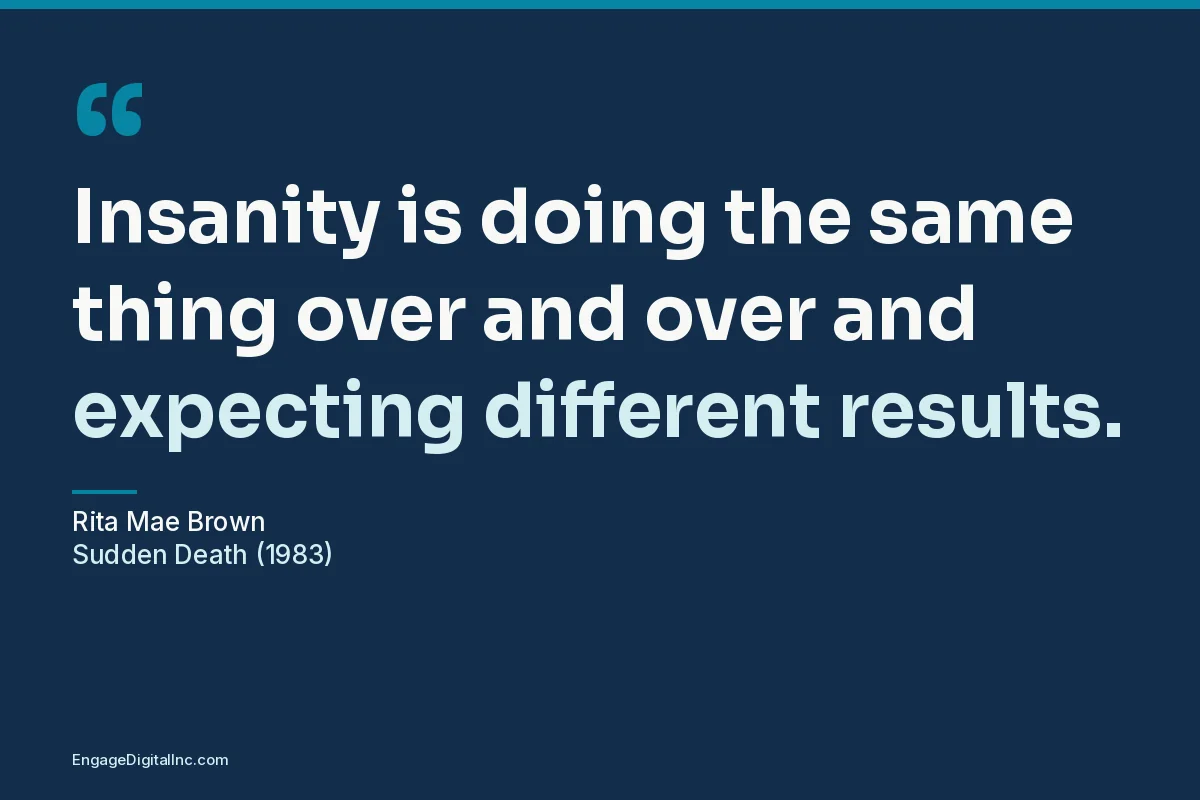
"Insanity is doing the same thing over and over and expecting different results." by American novelist Rita Mae Brown in her 1983 novel Sudden Death.
I've used this quote for decades and always believed it was Einstein's. I added it to this post from memory, then checked before attributing it, and found it in Rita Mae Brown's 1983 novel Sudden Death, with no record of Einstein saying it. It's the point of this post in miniature: what feels like knowledge isn't intelligence until it's verified.
Marketing gets smarter by counting only what actually worked. Collecting more doesn't get you there on its own.
How Can You Tell If Your Data Is Making You Smarter?
Ask how each finding was proven. If nobody can say, treat it as a guess. Ask these of any tool, team or partner that touches your marketing:
- What are we trying to move, and which numbers connect to it?
- Which of these findings were tested, and which are patterns someone noticed?
- How do we know that worked?
- What did we stop doing because the evidence said so?
- When a number goes up, how do we check it reflects real business and not tracking noise?
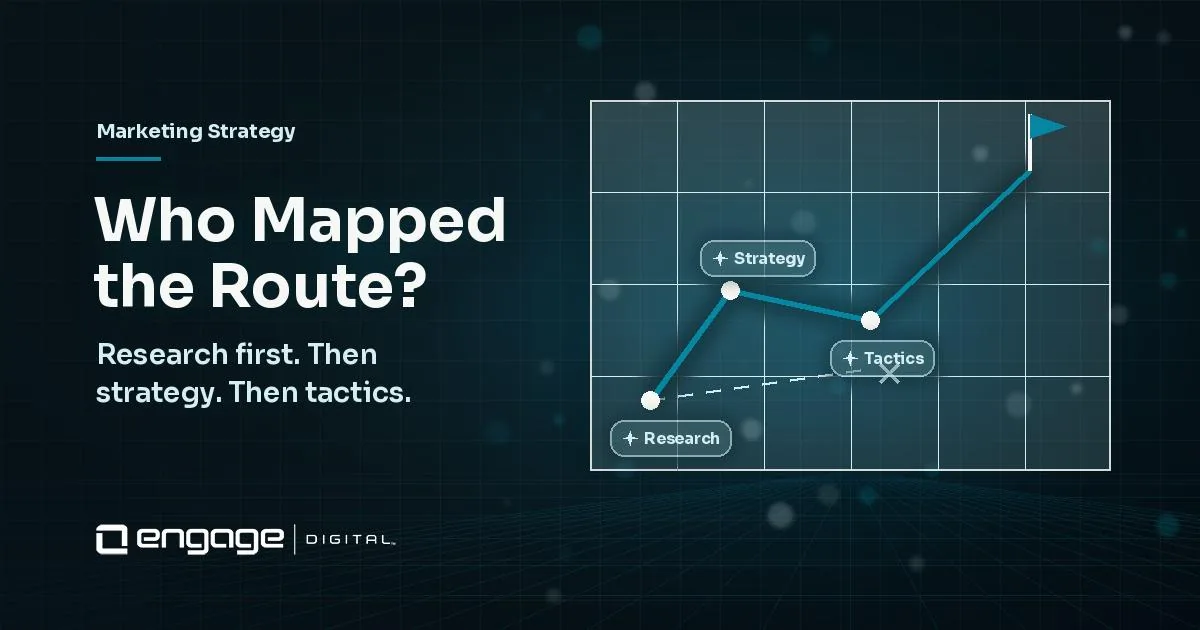
If the answers are vague, more data won't help. Better questions will. It's why we put research before strategy and strategy before tactics: the research decides which data deserves attention.
Why We're Building Engage Around This Principle
At Engage Digital, we're building an AI-powered marketing department, powered by the Engage AI marketing platform. Its core principle is this article's title.
So we're building it to keep proven results separate from guesses, and to count only what actually worked. It starts with directed research into your business, its presence, your competitors and your objectives. Strategy is built on that research, then the work is executed and adjusted toward those objectives, each change checked against what really happened.
That's how it gets smarter with every action: by learning from evidence, rather than piling up data. It's coming early 2027.
FAQ
Is More Data Always Better for AI?
No. More data helps when it adds new, accurate and relevant information. Redundant, wrong or untested data adds noise and can make guesses look like findings.
What Does “Garbage In, Garbage Out” Mean for AI Marketing?
AI can only be as good as what it's given. If your tracking double counts or your reports mix tested results with guesses, AI turns that into confident recommendations faster.
Sources
- U of T Engineering News, “U of T Engineering study finds bigger datasets might not always be better for AI models” (Nov 13, 2023)
- IBM Institute for Business Value, 2025 CEO Study press release (May 6, 2025)
- MIT Project NANDA, “The GenAI Divide: State of AI in Business 2025” (preliminary findings, July 2025)
- Gartner, “Lack of AI-Ready Data Puts AI Projects at Risk” (Feb 26, 2025)
- Adverity, “Fixing the Foundation: The State of Marketing Data Quality” (2025)
- Gartner, “Gartner Survey Reveals Marketing Analytics are Only Influencing 53% of Decisions” (Sep 15, 2022)
- Gartner, 2025 CMO Spend Survey press release (May 12, 2025)
Engage is an AI-powered marketing department, powered by the Engage AI marketing platform. It's coming early 2027.
Join the waitlist for progress updates as we build and the launch date as soon as we set it.