Key Takeaways
- The best AI prompts for business aren't one-liners. They're a leader's know-how written down so someone else can run it.
- The tool is secondary. Clarity is the breakthrough. A clear prompt works across people, offices and AI tools.
- A good handoff prompt covers five things: context, standards, the steps, what good looks like and when to escalate.
- Marketing works the same way. Clear direction can be repeated. Vague direction just gets repeated badly.
AI prompts for business work when they carry clear direction. Give five people the same question and the same AI tool, and you will get five different answers. The difference is how each person asks, not which model they use. That is prompting in plain terms, and it is why prompting matters for business results.
We built a version of this inside our own work. We had a process that took real time and real judgment, and we turned it into a written set of directions someone else could pick up and run. It worked better than we expected, and it taught us a lot about what travels and what doesn't.
We aren't going to walk through our specific situation here. It wouldn't apply to most businesses. What follows is the pattern we took from it: how to turn proven know-how into a handoff prompt anyone on your team can run.
Where Does a Leader's Time Actually Go?
Most business leaders don't build a company so they can spend their nights writing follow-up emails or answering every review by hand.
But that is where the time goes. New customers need follow-up after a first visit or first order. Online reviews need replies, good and bad, and they need to show that someone cares. None of it is optional. All of it is required. And all of it pulls leaders away from leading the business.
Every business has a version of this. The tasks that have to get done, done right, and somehow always land back on the same desk because nobody else does them quite the way the leader would.
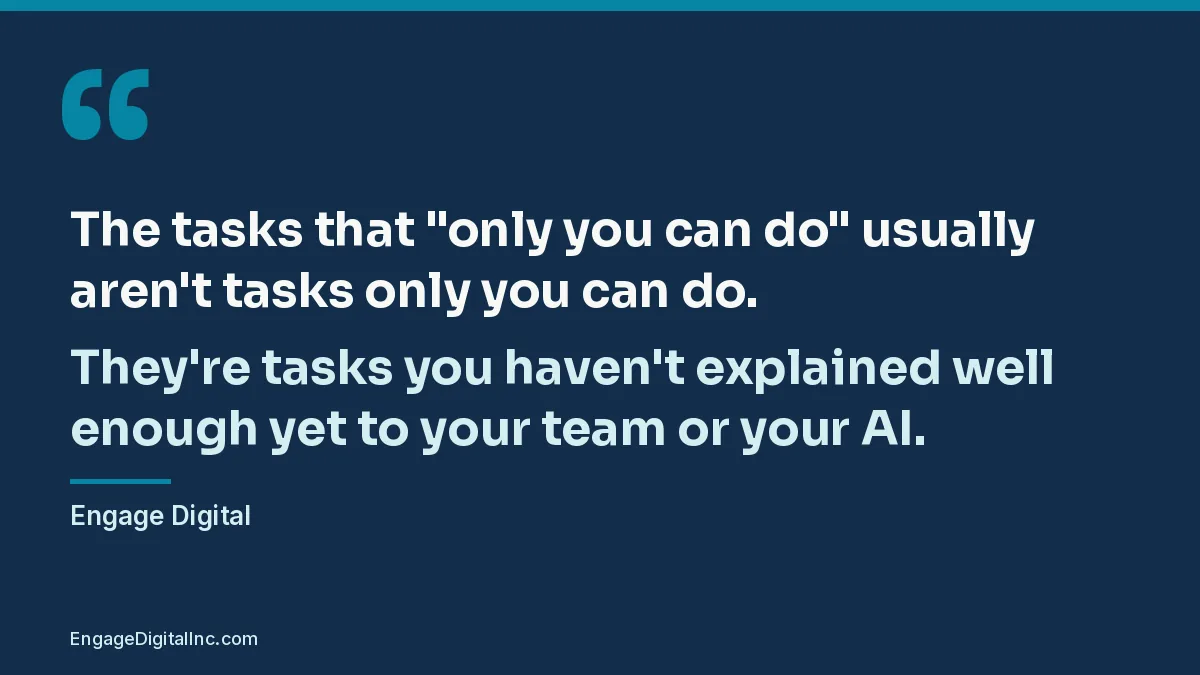
Here is a blunt truth from our experience. The tasks that "only you can do" usually aren't tasks only you can do. They're tasks you haven't explained well enough yet.
What Does a Working Handoff Actually Look Like?
The breakthrough is working the process out, then writing it down. A new tool alone does not get you there.
Initially, AI output is usually generic. Follow-ups sound like everyone else's. Review replies sound like a robot apologizing. So the direction has to get sharper. Who the customers are. How the business talks to people. What a great follow-up looks like and what a bad one looks like. Which situations need a personal call instead of a reply.
Over time, the output gets reliable. Not because the AI got smarter, but because the direction got clearer. And the clarity came from doing it right, not doing it the fastest way everyone else is doing it.
That is the part most people miss. Microsoft and LinkedIn's 2024 Work Trend Index found that 75% of knowledge workers already use AI at work (Microsoft and LinkedIn, 2024 Work Trend Index). Using AI isn't the advantage anymore. Knowing exactly what you want from it is.
Clarity is the breakthrough, not the tool. Prompting skill is the real gap.
What Goes Into a Handoff Prompt?
When the workflow is ready to hand off, don't send a tip sheet. Capture the whole workflow in one prompt. It should cover five things:
- Context. Who the business is, who the customers are and what the person running it is trying to accomplish.
- Standards. The tone, the rules and the things you never say.
- The steps. What happens first, next and last, in order.
- What good looks like. Real examples of a strong follow-up and a strong reply.
- When to escalate. The situations a human needs to handle personally.
Those are directions a smart new hire or an existing trusted team member would need on day one. Not tricks. Not magic words.
Why Does It Work for Someone Else?
This is the part that surprised us most when we did our own version.
A different person ran it. A different AI tool ran it. A different location, with different customers, used it. And the results held up.
That only happens when the thinking moves with the prompt. Judgment about the customers, the standards and the process was written down. The next person didn't have to guess what was meant. They adjusted the details for their situation, and the rest carried over.
If the prompt had been one line, "write a follow-up email to a new customer," it would have produced something generic on any tool, for anyone. Vague in, generic out. Same question, five people, five different answers. Clear direction is what makes the answers most useful.
What Does This Have to Do With Marketing?
Everything.
Strategy works the same way. A clear strategy and plan, built on directed research, with named objectives and a defined target customer, can be handed off and repeated. A new team member. An outside partner. A new AI tool. The direction travels. That order is the same one we walk through in Research First, Then Strategy, Then Tactics and in Know Your What, Know Your Why.
Vague direction travels too. It just gets repeated badly. "Get our name out there" turns into a hundred posts that aren't aimed at any objective. Activity without clear direction just burns time and budget. If that sounds familiar, Why Is My Marketing Not Working? covers the warning signs.
And the gap is real. In that same Microsoft and LinkedIn report, 60% of leaders said their company lacks a vision and plan to implement AI. The tools are everywhere. The direction isn't.
Most marketing doesn't fail because people aren't working hard or don't know enough. It fails because nobody wrote down where the work was supposed to point and what that looks like. That is the same problem a weak prompt creates, and the same fix applies: research, one strategy, then coordinated activity adjusted toward the objectives you clearly named. That is how we work as an AI-powered marketing department, powered by the Engage AI marketing platform at EngageDigitalInc.com.
How Do You Turn Your Own Workflow Into a Prompt?
Don't start from scratch. Starting from a blank page is where most of these efforts fall apart. Start from something you've already proven.
- Pick a workflow that's already working for you. Something you've refined until it reliably saves you time and gets the result you want. If it isn't proven yet, it isn't ready to hand off.
- Have your AI help you write it all down. Ask it to capture the full workflow as one long, highly descriptive prompt: the context, the standards, every step, what good looks like and when a person steps in. Ours ran five pages. That's the level of detail it takes.
- Remove what's only true for you. Your name, your location, your accounts, your personal preferences. Keep everything that made it work.
- Build in the questions. Wherever something has to be adjusted for the person you're handing it to, write a question their AI asks them before it starts. Their role, their location, their customers, their tools.
- Hand it off and review the first results together. The only thing they should have to do is answer the questions that are specific to them. Everything else is already decided.
Do that once and you've done more than save time. You've turned something proven in your business into something your whole team can repeat.
Better Direction Beats More Tools
Every month there's a new AI tool promising to impact everything. Some of them are great. None of them can read your mind.
The business leaders who get real results from AI prompts for business aren't the ones with the most tools. They're the ones who learn to identify exactly what they want, understand why they want it and can define what good looks like. That's true for AI. It's true for your team. And it's true for your marketing.
Clear, detailed direction beats more tools. Every single time.
Join the waitlist. The Engage AI marketing platform, the technology that will power our AI marketing department, is coming. Join the waitlist at EngageDigitalInc.com/subscribe for progress updates and our newsletter as we build. Or start on the EngageDigitalInc.com home page.
FAQ
What Makes a Good AI Prompt for Business?
Clear direction. A good business prompt gives context, sets standards, lays out the steps, shows what good looks like and says when a person should step in. The more of your judgment it carries, the better it works.
Will a Prompt Written for One AI Tool Work on Another?
Usually, if it is built on clear thinking rather than tool-specific tricks. When the direction is what matters, a different person can use a different tool and still get useful, consistent results.
How Long Should a Business Prompt Be?
As long as it needs to be to replace the questions someone would otherwise ask you. A short task might need half a page. A full workflow might need several.
Can a Prompt Be Handed to a Team Without Losing Control of Quality?
Yes, if it includes standards, real examples and clear escalation rules, and the first results are reviewed together. That is how the prompt gets better and the team gets confident.
Sources
Microsoft and LinkedIn, 2024 Work Trend Index, "AI at work is here. Now comes the hard part." (May 8, 2024; survey of 31,000 people in 31 countries): https://news.microsoft.com/2024/05/08/microsoft-and-linkedin-release-the-2024-work-trend-index-on-the-state-of-ai-at-work/
Engage is an AI-powered marketing department, powered by the Engage AI marketing platform. It's coming early 2027.
Join the waitlist for progress updates as we build and the launch date as soon as we set it.