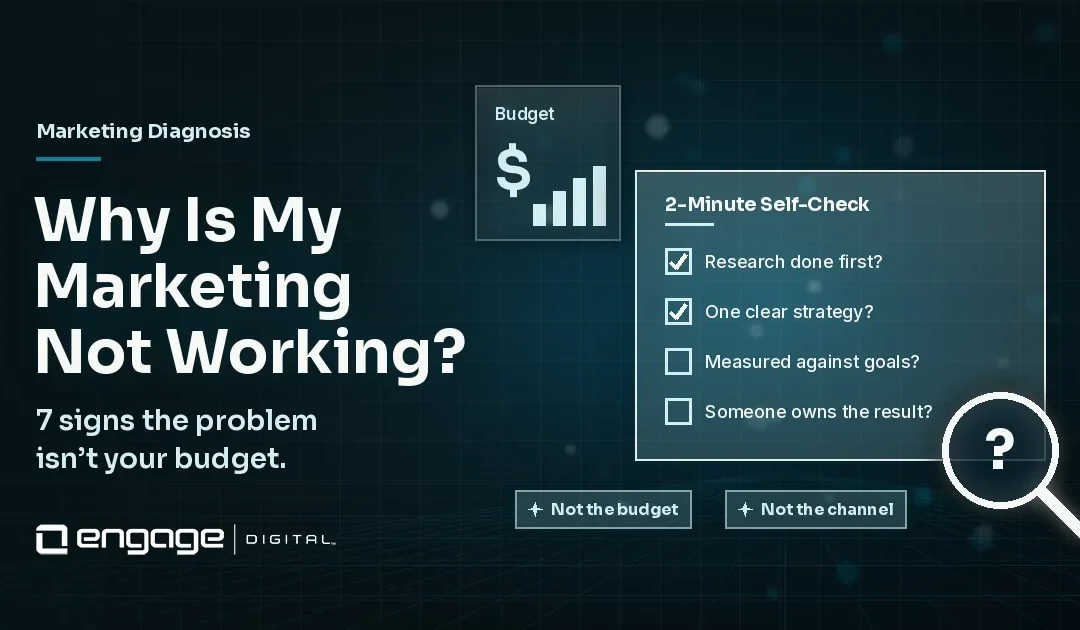
Why is my marketing not working? Usually it isn't the budget or the channel. It's the plan. Nobody did the research first, set one clear strategy, measured it against business goals, or owned the outcome. When those four pieces are missing, more money and new channels just make the same plan bigger.
Key Takeaways
- When marketing isn't working, the budget is rarely the root cause. The plan is.
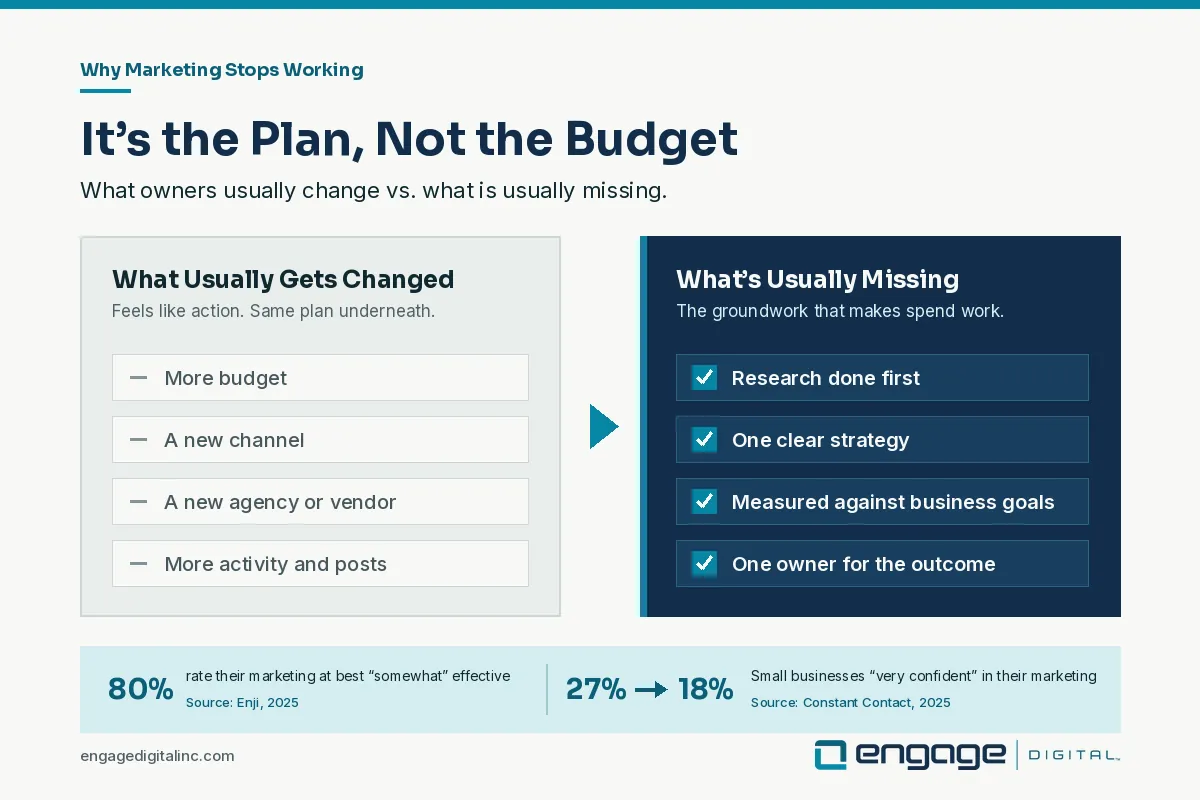
- Four things are usually missing: research done first and done correctly, one clear strategy, measurement against business goals, and one owner of the outcome.
- You're not alone. 80% rate their marketing at best "somewhat" effective (Enji, 2025). Small businesses "very confident" in their marketing fell from 27% to 18% (Constant Contact, 2025).
- Below: 7 signs the problem is your marketing plan, and a 2-minute marketing self-check you can run today.
- This is Part 1 of The Marketing Standard, a 16-part series by former agency CEO Robert Caruso on why marketing feels broken and what a better standard looks like.
What Is This Series About?
This article opens The Marketing Standard, a series from Engage Digital for business owners and leaders who think their marketing should be doing more. We will be posting over 16 articles that will take a look at why marketing feels broken. Then why it breaks: a plan without strategy, tactics without research, and execution nobody measures or owns. Then we will drive to a clear standard that you can use to judge any marketing partner, us included. And finally, where AI helps to this end and where it can make things even worse.
Each article in this series will stand on its own. Read in order, they address one argument. Let’s kick this off with the question most owners ask first.
Why Isn't My Marketing Working When I'm Spending More?
Because more spend scales the plan you already have, gaps included.
You're not imagining the problem, and you're not the only one doing this either. In Enji's State of Small Business Report 2025, 80% of business leaders rate their marketing at best "somewhat" effective. In Constant Contact's 2025 Small Business Now report, small businesses "very confident" in their marketing fell from 27% to 18%. That happened while many of them raised their marketing spend. The same report says the top frustration is not knowing what's working.
Read that again. Effort is up. Money is up. And often staffing is up as well. Confidence is down. If budget were the problem, more budget would have fixed it. It won’t.
When marketing momentum stalls, most businesses pull the same fear-based levers. You can’t necessarily blame them. It’s instinctive. More budget. A new channel. A new agency or vendor. More posts. Each one feels like progress. But if the plan underneath doesn't change, the results usually don't either. (If budget really is tight, our guide to marketing budget strategies for economic downturns covers how to spend with discipline.)
Is It a Budget Problem or a Plan Problem?
It's a plan problem far more often than a budget problem. Here's the difference in two sentences.
A budget problem is a sound plan that can't reach enough of the right target prospects because it's underfunded. It’s a proven marketing activity that only needs scale attached to compound.
A plan problem is money being spent without proper research, a clear proven strategy, measurement against business goals, or the right owner of the outcome.
The seven signs below are grouped around the four missing pieces: research done first (Signs 1 and 2), one clear strategy (Signs 3 and 4), measurement against business goals (Signs 5 and 6) and one owner for the outcome (Sign 7). If several sound familiar, start by addressing the plan.
Sign 1: Can You Say Who Your Target Customer Is, and Why They'd Buy From You?
If you can't describe your target customer in two very detailed sentences, your marketing is aimed at everyone, and that usually means no one.
Try it. Who are they, what problem do they have, and why would they pick you over the alternatives? Vague answers like "small businesses" or "anyone who needs our service" are the tell. You need a sniper rifle, and you’re carrying a shotgun you don’t know how to aim.
Here’s how I define marketing research: the work of learning who your target buyers are, what they need, and how they decide, before you spend anything on marketing. In my experience leading an agency, it’s the step that gets skipped most often. It comes from talking to customers, looking at what they search for and ask about, and studying why deals are won and lost. The data you already hold is a good place to start; we cover that in how to use first-party data in your marketing. But the research shouldn’t end there; it’s just the beginning.
What to do: Write down your target customer and their top reason for buying. Answer what their pain points are in detail and define clearly how you solve them. Identify the friction within your processes that would prevent or slow down their decision processes. If you haven’t done all of that easily, that's the first project. Do it before any new spend.
Sign 2: Did Anyone Study the Market Before the Spending Started?
If your plan started with tactics instead of research, it was built on assumptions.
A lot of plans begin with a channel. "We need to be on social." "We need SEO." "Let's run ads." Then the work starts. The step that gets skipped is the one that really matters: what competitors are doing, where buyers actually look for help, what they already believe about your category, and where the real openings are.
What I’ve seen over and over is that skipping research doesn't save time. It moves the cost to later, when campaigns underperform and nobody can say why.
What to do: Ask for the research behind your current plan. If there isn't any, or it's a template that could describe any business, you've found the gap. It’s time to dig in!
Sign 3: Is Your "Strategy" Really a List of Tactics?
If your plan primarily lists activities, you have tactics, not a strategy.
Open your marketing plan. Does it say what you're trying to achieve, who you're trying to reach, what you'll tell them, and why it should work? Or is it four posts a week, a monthly newsletter, an ad budget and a blog?
After decades of leading an agency, here’s how I define a marketing strategy: the reasoning that decides which tactics are worth doing and how they work together. Tactics are just the activities you’ll be doing. In my experience, you can finish every task on a tactics list and still go nowhere. The plan connects the what with the why. Big difference!
What to do: State your strategy in one or two sentences. If all you can describe is activity, the strategy is missing.
Sign 4: Do You Change Channels or Vendors Every Few Months?
Constant switching is a sign there was never one strategy holding things together.
New platform. New agency. New freelancer. New tool. When your marketing history is a string of fresh starts, nothing runs long enough, or connected enough, to work. Every change resets the clock.
The same thing happens with several vendors at once. The ads person, the social person and the web developer can each do good work and still pull in different directions. Without one unified strategy, there's nothing to line them up. You’re doing tactics without an endzone and your chance to score requires one!
What to do: List every channel and vendor you've used in the last two years and why each one changed. If the answer keeps being "it wasn't working," with no real diagnosis behind it, the strategy is what's been missing.
Sign 5: Do Your Reports Show Activity Instead of Business Results?
If your report is full of impressions and clicks but light on leads and sales, you're being shown effort, not outcomes.
Impressions, reach, clicks, followers, posts published. These prove work happened. They don't prove it helped. This is a big reason confidence keeps falling while effort and activity continually rise. When reports measure activity, owners can't see what's working, so every decision turns into guessing. Guessing in marketing has a worse chance of results than buying a lottery ticket!
The same discipline applies when a number drops. Our guide on how to fix an organic SEO traffic drop walks through finding the cause before changing anything.
What to do: Ask for a report that starts with the business numbers you care about and works back to the activity that drove them. If nobody can connect the two, that's one of many gaps.
Sign 6: Do You Know What "Working" Would Actually Look Like?
You can't judge marketing against a goal that was never written down.
Was the goal more qualified leads? More booked appointments? A bigger average order? A new market? If nobody agreed on it and tied it to the business, there's no fair way to judge results, and no signal for when to change course.
Goals are not hopeful outcomes. They are detailed and defined. They require knowledge and experience. The most effective objectives are connected to why and how, with definitions that move from general and obscure to targeted.
What to do: Pick one or two business goals for each of your marketing campaigns. Agree on how they'll be measured before the next dollar goes out. Everything else should serve that end.
Sign 7: When Results Slip, Does Anyone Own the Fix?
If a dip leads to finger-pointing or a request for more budget, nobody owns the outcome.
Watch what happens when the numbers fall. Vendors blame each other. Someone mentions "the algorithm." Someone asks for more money. People own tasks. Nobody owns the result.
What I’ve seen over and over is that marketing only improves when someone owns it. Here’s my definition: marketing ownership means one person or team is accountable for the outcome, not just the activity. They watch the right numbers, explain what changed and decide what happens next. Without that, problems linger and the same plan keeps running.
What to do: Name who owns your marketing results. If the answer is "everyone," or "the agency, sort of," it's no one.
From the Inside, by Robert Caruso
I’ve led a marketing agency for decades, so I've sat on both sides of the table. When a client told us "our marketing isn't working," the first instinct, theirs and ours, was to change something you could see. Bigger budget. New channel. Fresh campaign. It felt like progress. When we honestly looked, the gap was almost always further back. The research that had been done was often driven and owned by the client and couldn’t be defined or tested. The strategy migrated to a client driven list of tactics and tasks that they required. The reporting demand increased and they wanted to measure our activity and often made us increase it. And nobody was allowed to own the results. More spend didn't fix any of that. It just made it more expensive, time consuming and ineffective. We don’t play games with planning anymore.
How Can You Check Your Marketing in 2 Minutes?
Answer yes or no to these seven questions. Be honest. Nobody's grading this but you.
- Can I describe my target customer and why they buy, in two sentences?
- Was there real research behind my current marketing plan?
- Can I state my marketing strategy in one or two sentences without listing tactics?
- Has my strategy held steady long enough to judge it, even if tactics changed?
- Does my monthly report start with business outcomes in mind, not activity?
- Did we agree on what "working" means before we started spending and working?
- Is one named person or team accountable for marketing results?
How to read it: Each "no" points to a missing piece. Questions 1 and 2 are research. Questions 3 and 4 are strategy. Questions 5 and 6 are measurement. Question 7 is ownership. Three or more "no" answers usually means the problem is the plan, and more budget won't solve it. Start with your earliest "no." Research comes first because everything else depends on it.
Frequently Asked Questions
Why Is My Marketing Not Working?
Usually because the plan is missing one or more of four things: research done first and correctly, one clear strategy, measurement against business goals, or an owner for the outcome. Budget and channel are rarely the root cause. Fix the plan first, then decide whether the budget needs to change.
Why Am I Not Getting Results From My Marketing?
Most often the marketing is measured by activity, not by a business goal agreed in advance. Without a written goal and a report tied to it, you can't see what's working or what to change. Set the goal, then judge every tactic against it.
How Long Does It Take for Marketing to Work?
It depends on the channel and the goal. Paid search can show signals quickly. Content and SEO build over time. What should never take long is seeing whether you're moving toward a defined business goal. If you can't see that, the problem is measurement, not patience.
How Do I Know If My Marketing Is Working?
Start with a written business goal, then check whether your reports connect marketing activity to it. If they don't, you can't tell. A later article in this series gives owners a simple scorecard for exactly this question.
Should I Switch Marketing Agencies?
Maybe, but diagnose first. If you switch without fixing missing research, strategy, measurement or ownership, the next partner inherits the same problem. Run the self-check above, then ask any current or future partner how they handle each of the four pieces.
What Comes Next in This Series?
If you answered "no" a few times, it's not that you missed something. Most owners were never given a clear way to see what's working, or a standard to judge their marketing against. That's what this series is for.
Next in The Marketing Standard: "Can AI Replace a Marketing Agency? 10 Pitfalls of DIY AI Marketing." It covers what AI can and can't take off your plate, and how to check a DIY AI stack before you trust it. After that: "Is a Marketing Agency Worth It for a Small Business? An Honest Answer From a Former Agency CEO."
Join the Engage Digital Waitlist
More spend alone won't fix it. Research forged into a real strategy with results as the goal will. Engage Digital is building something new for how marketing gets done, and waitlist members get early access.
About the Author
Robert Caruso is the founder and CEO of Engage Digital Inc. and a former marketing agency CEO. He writes about why marketing stalls and what it takes to fix it: research, strategy, measurement and ownership.
Engage Digital Inc. (engagedigitalinc.com) is a Tampa, Florida digital marketing agency building a new model for how marketing gets planned, aimed and measured. The Engage Blog explains that model in plain English.
Sources
- Enji, State of Small Business Report 2025 (245 small business owners, surveyed September 2025): https://www.enji.co/state-of-small-business-report-2025
- Constant Contact, Small Business Now 2025: The State of Small Business Marketing (2,500 small business decision-makers in the US, UK, Canada and Australia/New Zealand, surveyed by Ascend2 Research, June 2025): https://news.constantcontact.com/2025-09-03-The-State-of-Small-Business-Marketing-Effort-is-Up-While-Confidence-Has-Declined
- Constant Contact, "Small Business Now Report: What You Need to Know": https://www.constantcontact.com/blog/small-business-now-report/